Expert summary statistics
Implicitly, neural estimators involve the learning of summary statistics. However, some summary statistics are available in closed form, simple to compute, and highly informative (e.g., sample quantiles, the empirical variogram). Often, explicitly incorporating these expert summary statistics in a neural estimator can simplify training and lead to a better estimator.
In the following examples, we develop a neural estimator to infer
Package dependencies
using NeuralEstimators
using Statistics: mean, std
using CairoMakie
To improve computational efficiency, various GPU backends are supported. Once the relevant package is loaded and a compatible GPU is available, it will be used automatically:
using CUDA, cuDNNusing AMDGPUusing Metalusing oneAPISelect a deep-learning backend:
using Lux, Zygoteusing FluxExpert summaries only
A neural estimator based only on user-defined expert summary statistics (see, e.g., Gerber and Nychka, 2021; Rai et al., 2024; Lambe et al, 2026) can be constructed by omitting the summary network and providing the expert summaries as a matrix.
Sampling parameters and simulating data
We first define functions to sample parameters from the prior distribution and to simulate data. Since there are no replicates here, the simulator returns a vector of summary statistics directly for each parameter vector:
d = 2              # dimension of θ
num_summaries = 3  # number of expert summaries

# Function to sample from the prior
sampler(K) = NamedMatrix(μ = randn(K), σ = rand(K))

# Function to simulate data
function simulator(θ::AbstractVector, n::Integer)
    Z = θ["μ"] .+ θ["σ"] .* randn(n)
    S = [mean(Z), std(Z), log(n)]
    return S
end
simulator(θ::AbstractVector, n) = simulator(θ, rand(n))
simulator(θ::AbstractMatrix, n) = reduce(hcat, simulator.(eachcol(θ), Ref(n)))
Since the simulator returns summary statistics rather than raw data, it is the distribution of those statistics that the estimator sees. Plotting them over draws from the prior, and over the range of sample sizes used during training, shows what information is available to it:
θ = sampler(1000)
S = simulator(θ, 30:1000)

labels = ["Sample mean", "Sample standard deviation", "log(n)"]
fig = Figure(size = (900, 250))
for j in 1:3
    ax = Axis(fig[1, j], xlabel = labels[j])
    hist!(ax, S[j, :], bins = 30, color = (:black, 0.6))
end
fig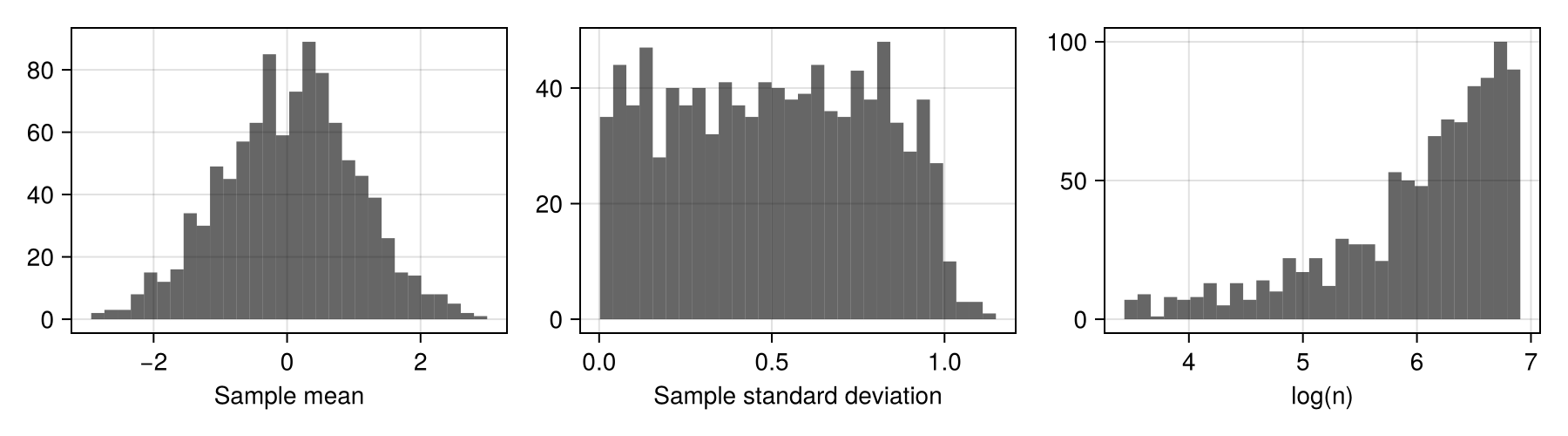
Constructing the neural estimator
Since the summary statistics are precomputed, no summary network is needed: omit it and pass num_summaries in the usual way.
estimator = PointEstimator(d; num_summaries = num_summaries)estimator = PosteriorEstimator(d; num_summaries = num_summaries, q = GaussianMixture)estimator = RatioEstimator(d; num_summaries = num_summaries)Training the estimator
Next, we train the estimator using train. We train over a range of sample sizes so that the estimator learns to handle varying
# Sample sizes used during training
n_training = 30:1000

estimator = train(estimator, sampler, simulator; simulator_args = (n_training,))
Training progress is reported in the terminal:

The empirical risk (average loss) over the training and validation sets can be plotted using plotrisk:
plotrisk()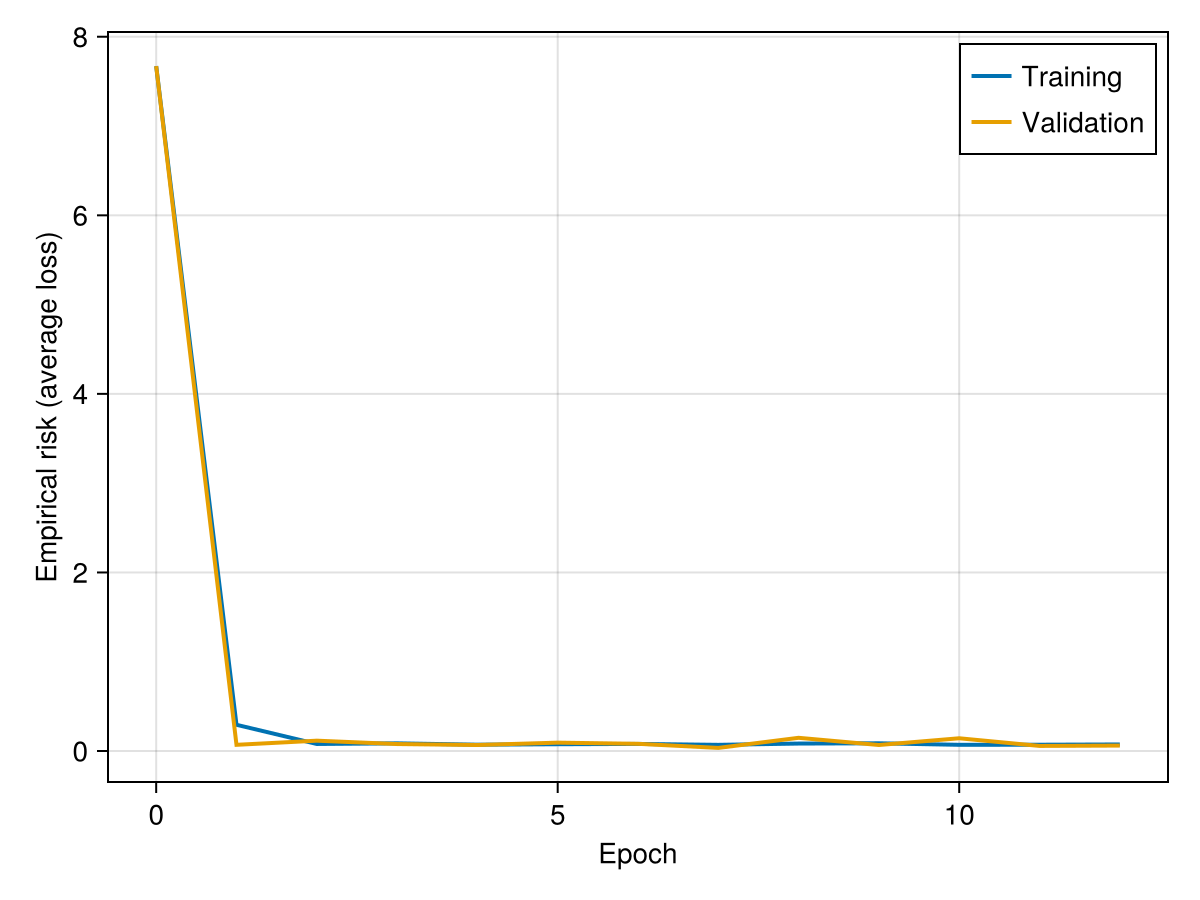
Assessing the estimator
The function assess can then be used to assess the trained estimator based on unseen test data:
n_test = 500
θ_test = sampler(1000)
Z_test = simulator(θ_test, n_test)

assessment = assess(estimator, θ_test, Z_test)
bias(assessment)
rmse(assessment)
plot(assessment)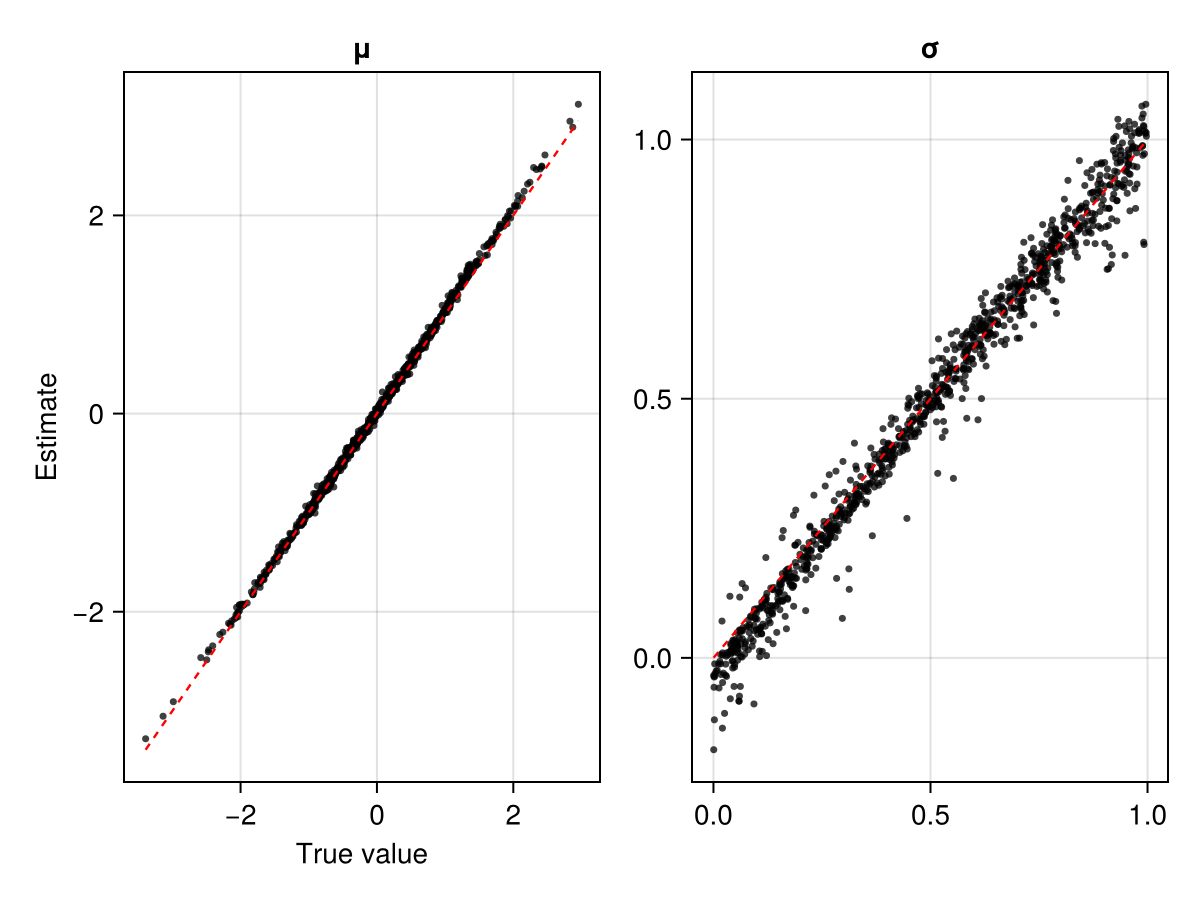
Applying the estimator to observed data
Once an estimator is deemed to be well calibrated, it may be applied to observed data (below, we use simulated data as a stand-in for observed data):
θ = sampler(1)                   # ground truth (not known in practice)
Z = simulator(θ, n_test) # stand-in for real observationsestimate(estimator, Z) # point estimatesampleposterior(estimator, Z) # posterior samplesampleposterior(estimator, Z) # posterior sampleExpert and learned summaries
The fusion of expert and learned summary statistics is facilitated by DataAndSummaries, which couples raw data with precomputed expert summary statistics. This allows the estimator to benefit from both the interpretability and efficiency of expert summaries and the flexibility of learned representations.
Sampling parameters and simulating data
The simulator returns a DataAndSummaries object that pairs the raw data with a matrix of precomputed expert summaries. The expert summaries (here, the sample mean and standard deviation) are computed over the replicate dimension and will be concatenated with the learned summaries before being passed to the inference network:
d = 2    # dimension of θ
n = 100  # number of replicates (fixed in this example)

# Function to sample from the prior
sampler(K) = NamedMatrix(μ = randn(K), σ = rand(K))

# Functions to simulate data
function simulator(θ::AbstractVector)
    Z = θ["μ"] .+ θ["σ"] .* sort(randn(n))
    return Z
end
function simulator(θ::AbstractMatrix)
    Z = reduce(hcat, map(simulator, eachcol(θ)))
    S = vcat(mean(Z, dims = 1), std(Z, dims = 1))
    return DataAndSummaries(Z, S)
end
Constructing the neural estimator
We construct a summary network that maps the raw data to a set of learned summary statistics, and specify num_summaries as the total number of expert and learned summaries combined:
num_expert_summaries  = 2
num_learned_summaries = 3d
summary_network = Chain(Dense(n, 64, gelu), Dense(64, 64, gelu), Dense(64, num_learned_summaries))estimator = PointEstimator(summary_network, d; num_summaries = num_expert_summaries + num_learned_summaries)estimator = PosteriorEstimator(summary_network, d; q = GaussianMixture, num_summaries = num_expert_summaries + num_learned_summaries)estimator = RatioEstimator(summary_network, d; num_summaries = num_expert_summaries + num_learned_summaries)Training the estimator
Next, we train the estimator using train:
estimator = train(estimator, sampler, simulator)Training progress is reported in the terminal:

Assessing the estimator
The function assess can then be used to assess the trained estimator based on unseen test data:
θ_test = sampler(500)
Z_test = simulator(θ_test)

assessment = assess(estimator, θ_test, Z_test)
bias(assessment)
rmse(assessment)
plot(assessment)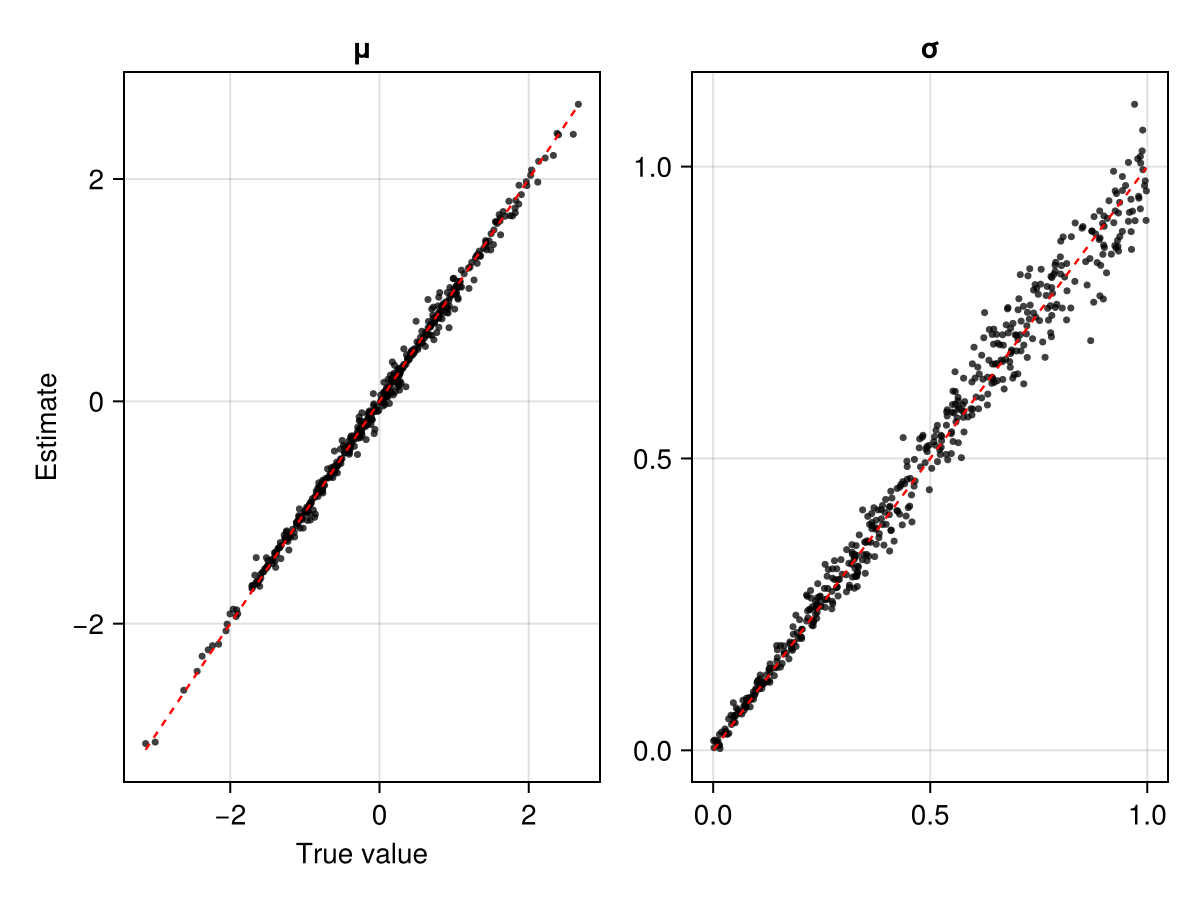
Applying the estimator to observed data
Once an estimator is deemed to be well calibrated, it may be applied to observed data (below, we use simulated data as a stand-in for observed data):
θ = sampler(1)                 # ground truth (not known in practice)
Z = simulator(θ) # stand-in for real observationsestimate(estimator, Z) # point estimatesampleposterior(estimator, Z) # posterior samplesampleposterior(estimator, Z) # posterior sample