Irregular spatial data
Here, we develop a neural estimator for a spatial Gaussian process model with exponential covariance function and unknown range parameter
Package dependencies
using NeuralEstimators
using Flux
using GraphNeuralNetworks
using Distributions: Uniform
using CairoMakie
using Distances
using Folds                    # parallel simulation (start Julia with --threads=auto)
using LinearAlgebra            # Cholesky factorisation
using Statistics: mean
To improve computational efficiency, various GPU backends are supported. Once the relevant package is loaded and a compatible GPU is available, it will be used automatically:
using CUDA, cuDNNusing AMDGPUusing Metalusing oneAPISampling parameters
The overall workflow follows previous examples, with two key additional considerations. First, if inference is to be made from a single spatial data set collected at fixed locations, training data can be simulated at those same locations. However, if the estimator is intended for multiple spatial data sets with varying configurations, it should be trained on a diverse set of configurations, which can be sampled using a spatial point process such as maternclusterprocess. Second, spatial data should be stored as a graph using spatialgraph.
As in the gridded example, simulation from Gaussian processes involves expensive intermediate objects (Cholesky factors). Here, we additionally store the spatial graphs needed for graph convolutions. We define a custom type Parameters subtyping AbstractParameterSet:
struct Parameters <: AbstractParameterSet
	θ   # parameters
	L   # Cholesky factors
	g   # spatial graphs
	S   # spatial locations
end
We define two constructors: one that accepts an integer and samples from the prior (used during training), and one that accepts a parameter matrix and spatial locations directly (possibly used for parametric bootstrap):
function sampler(K::Integer)
	θ = 0.5 * rand(1, K)

	# Sample spatial configurations from a Matérn cluster process on [0, 1]²
	n = rand(200:300, K)
	λ = rand(Uniform(10, 50), K)
	S = [maternclusterprocess(λ = λ[k], μ = n[k]/λ[k]) for k ∈ 1:K]

	Parameters(θ, S)
end

function Parameters(θ::Matrix, S)
	# Covariance matrices and Cholesky factors
	L = Folds.map(axes(θ, 2)) do k
		D = pairwise(Euclidean(), S[k], dims = 1)
		Σ = Symmetric(exp.(-D ./ θ[k]))
		cholesky(Σ).L
	end

	# Spatial graphs
	g = spatialgraph.(S)

	Parameters(θ, L, g, S)
end
Simulating data
We also employ a sparse approximation of the empirical variogram as an expert summary statistic (Gerber and Nychka, 2021). This is precomputed in the simulator and returned alongside the graphs via DataAndSummaries.
h_max = 0.15   # maximum distance to consider
q = 10         # number of variogram bins
nv = NeighbourhoodVariogram(h_max, q)

function simulator(parameters::Parameters, m)
	K = size(parameters, 2)
	m = rand(m, K)
	Z = map(1:K) do k
		L = parameters.L[k]
		g = parameters.g[k]
		n = size(L, 1)
		Z = L * randn(n, m[k])
		spatialgraph(g, Z)
	end
	S = reduce(hcat, nv.(Z))
	return DataAndSummaries(Z, S)
end
simulator(parameters::Parameters, m::Integer = 1) = simulator(parameters, range(m, m))
Varying the number of replicates
The simulator above draws m independently for each data set, so the data sets in a batch may hold different numbers of replicates (e.g., simulator(parameters, 1:10)). This is handled efficiently: a batch of graphs is packed into a single supergraph on the host, with the replicate dimension padded to a common length and the padded entries masked, so it costs one graph neural network forward pass rather than one per data set. The only restriction is that no layer of the propagation module may mix information across the replicate dimension, which rules out normalisation layers such as BatchNorm.
Plotting a few simulated data sets shows both the irregular spatial configurations sampled from the cluster process and the effect of the range parameter:
parameters = Parameters(reshape([0.05, 0.15, 0.5], 1, 3),
	[maternclusterprocess(λ = 30, μ = 10) for _ in 1:3])
Z = simulator(parameters)

fig = Figure(size = (900, 300))
for k in 1:3
	S = parameters.S[k]
	ax = Axis(fig[1, k], title = "θ = $(parameters.θ[k])", aspect = DataAspect())
	hidedecorations!(ax)
	scatter!(ax, S[:, 1], S[:, 2], color = vec(Z.Z[k].ndata.Z), colormap = :balance)
end
fig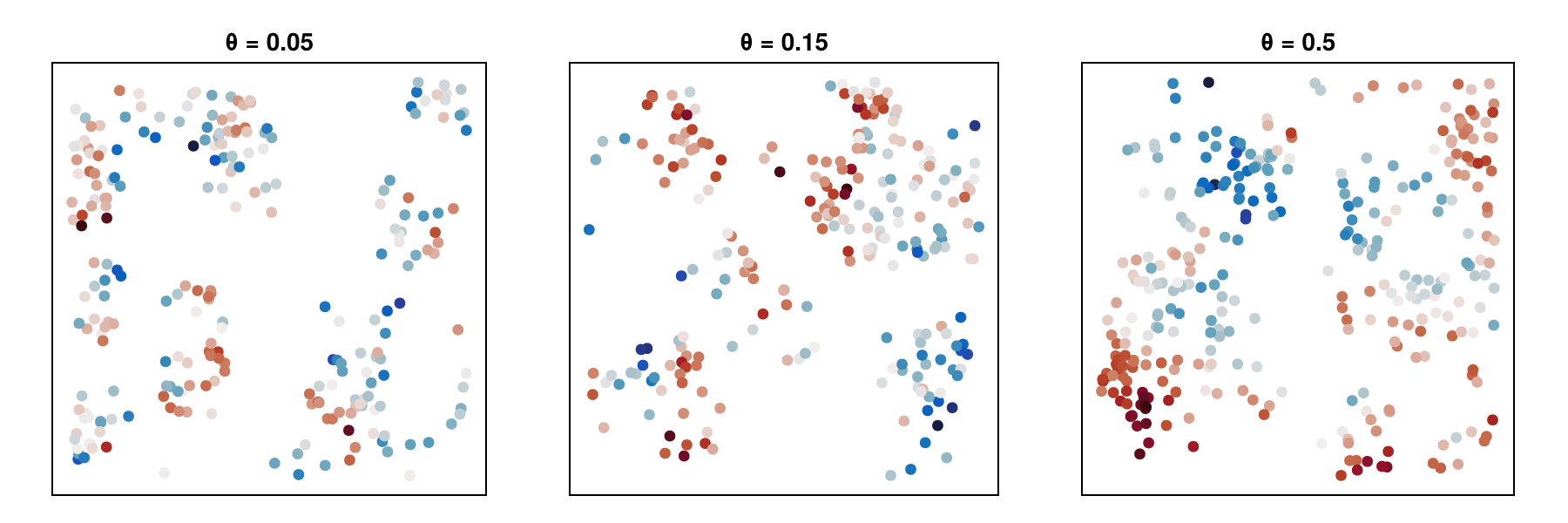
Constructing the neural network
We use a GNN architecture tailored to isotropic spatial dependence models; for further details, see Sainsbury-Dale et al. (2025, Sec. 2.2). The empirical variogram computed in the simulator is concatenated with the learned GNN summaries via DataAndSummaries; see Expert summary statistics.
d = 1                       # dimension of the parameter vector θ
num_learned_summaries = 3d  # number of learned summary statistics for θ
num_expert_summaries  = q   # NeighbourhoodVariogram bins

# Spatial weight functions: continuous surrogates for 0-1 basis functions
w = KernelWeights(h_max, q)

# Propagation module
propagation = Chain(
	SpatialGraphConv(1 => q, relu, w = w, w_out = q),
	SpatialGraphConv(q => q, relu, w = w, w_out = q)
)

# Readout module
readout = GlobalPool(mean)

# Inner network
ψ = GNNSummary(propagation, readout)

# Outer network
ϕ = Chain(
	Dense(q, 128, relu),
	Dense(128, 128, relu),
	Dense(128, num_learned_summaries)
)

# DeepSet object
network = DeepSet(ψ, ϕ)
Constructing the neural estimator
We now construct a neural estimator by wrapping the neural network in the subtype corresponding to the intended inferential method:
estimator = PointEstimator(network, d; num_summaries = num_learned_summaries + num_expert_summaries)estimator = PosteriorEstimator(network, d; num_summaries = num_learned_summaries + num_expert_summaries)estimator = RatioEstimator(network, d; num_summaries = num_learned_summaries + num_expert_summaries)Training the estimator
K = 1000
θ_train = sampler(K)
θ_val   = sampler(K)
estimator = train(estimator, θ_train, θ_val, simulator, epochs = 10)
Training progress is reported in the terminal:

The empirical risk (average loss) over the training and validation sets can be plotted using plotrisk:
plotrisk()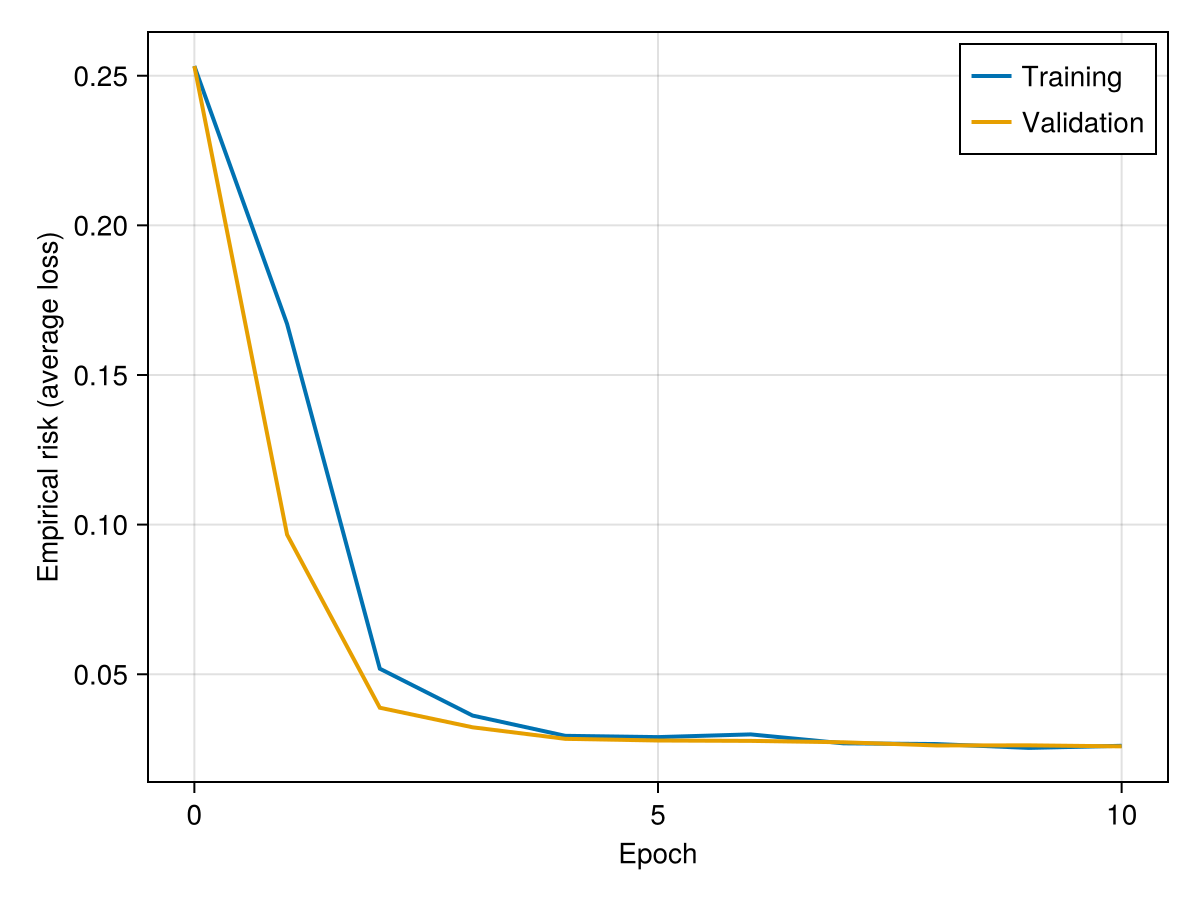
One may wish to save a trained estimator and load it in a later session: see Saving and loading estimators for details on how this can be done.
Assessing the estimator
The function assess can be used to assess the trained estimator:
θ_test = sampler(1000)     # test parameters
Z_test = simulator(θ_test) # test data
assessment = assess(estimator, θ_test, Z_test)
The resulting Assessment object contains ground-truth parameters, estimates, and other quantities that can be used to compute quantitative and qualitative diagnostics:
bias(assessment)
rmse(assessment)
risk(assessment)
plot(assessment)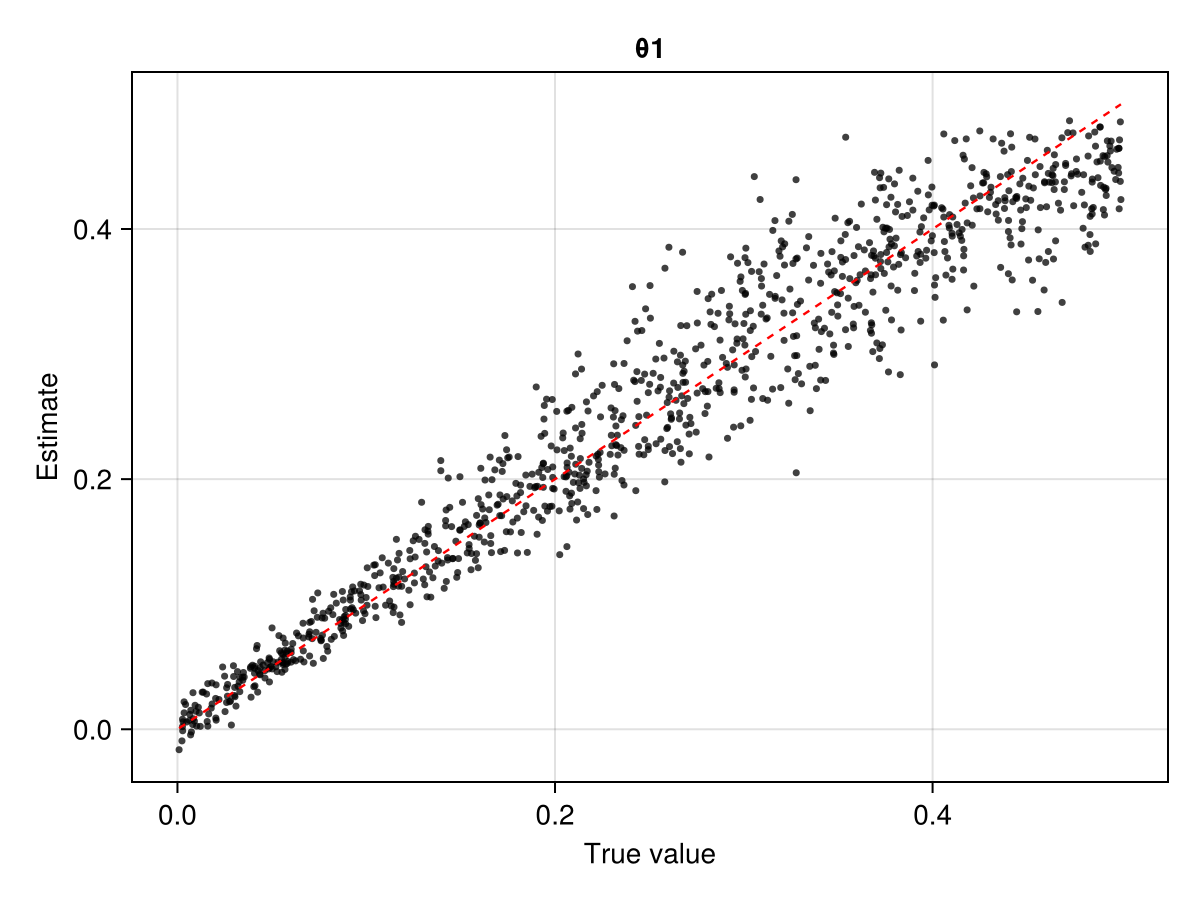
Applying the estimator to observed data
Once an estimator is deemed to be well calibrated, it may be applied to observed data (below, we use simulated data as a stand-in for observed data). Since the estimator was trained on spatial configurations in the unit square, the spatial coordinates of observed data should be scaled to lie within this domain; estimates of any range parameters are then scaled back accordingly.
parameters = sampler(1)        # ground truth (not known in practice)
θ = parameters.θ               # true parameters
S = parameters.S               # "observed" locations
Z = simulator(parameters) # stand-in for real dataestimate(estimator, Z) # point estimatesampleposterior(estimator, Z) # posterior samplesampleposterior(estimator, Z) # posterior sample