Time-series data
Here, we develop a neural estimator to infer parameters from a
observed over
Package dependencies
using NeuralEstimators
using CairoMakie
using LinearAlgebra
using MatrixEquations: lyapd
using MLUtils: flatten
To improve computational efficiency, various GPU backends are supported. Once the relevant package is loaded and a compatible GPU is available, it will be used automatically:
using CUDA, cuDNNusing AMDGPUusing Metalusing oneAPISelect a deep-learning backend:
using Fluxusing Lux
# NB: for the most computationally efficient setup, pass device = reactant_device() to train()
using Reactant
Reactant.set_default_backend("gpu")Sampling parameters
We first define a function to sample parameters from the prior distribution. Each column of the returned NamedMatrix holds a single draw: the four entries of
function sampler(K)
    p = 2   # dimension of the VAR process
    A = Matrix{Float64}(undef, p^2, 0)
    while size(A, 2) < K
        candidates = 0.5 .* randn(p^2, 2K)   # oversample then filter
        valid = [ρ(reshape(candidates[:, k], p, p)) < 1 for k in 1:2K]
        A = hcat(A, candidates[:, valid])
    end
    NamedMatrix(
        A₁₁ = A[1, 1:K],
        A₁₂ = A[2, 1:K],
        A₂₁ = A[3, 1:K],
        A₂₂ = A[4, 1:K],
        σ₁  = abs.(0.5 .* randn(K)),
        σ₂  = abs.(0.5 .* randn(K)),
    )
end

ρ(A) = maximum(abs.(eigvals(A)))   # spectral radius
Simulating data
Next, we define the statistical model through simulation. Each data set is a single multivariate time series of length
function simulator(θ::AbstractVector, T::Integer; stationary_init::Bool = true)
    p = 2   # dimension of the VAR process
    A = reshape([θ["A₁₁"], θ["A₁₂"], θ["A₂₁"], θ["A₂₂"]], p, p)
    σ = [θ["σ₁"], θ["σ₂"]]
    Z = Matrix{Float64}(undef, p, T)
    Z[:, 1] = if stationary_init
        Σ = lyapd(A, Diagonal(σ.^2)) # solve Σ = AΣAᵀ + diag(σ²)
        L = cholesky(Σ).L
        L * randn(p)
    else
        σ .* randn(p)
    end
    for t in 2:T
        Z[:, t] = A * Z[:, t-1] + σ .* randn(p)
    end
    return Z
end
simulator(θ::AbstractMatrix, T::Integer) = stack([simulator(ϑ, T) for ϑ in eachcol(θ)])
Plotting a couple of simulated series is a useful check that the sampler and simulator agree, and shows the variety of dynamics implied by the prior:
θ = sampler(2)
Z = simulator(θ, 100)

fig = Figure(size = (900, 350))
for k in 1:2
    ax = Axis(fig[k, 1], xlabel = k == 2 ? "t" : "", ylabel = "Z")
    lines!(ax, Z[1, :, k], label = "Z₁")
    lines!(ax, Z[2, :, k], label = "Z₂")
    k == 1 && axislegend(ax, position = :rt, orientation = :horizontal)
end
fig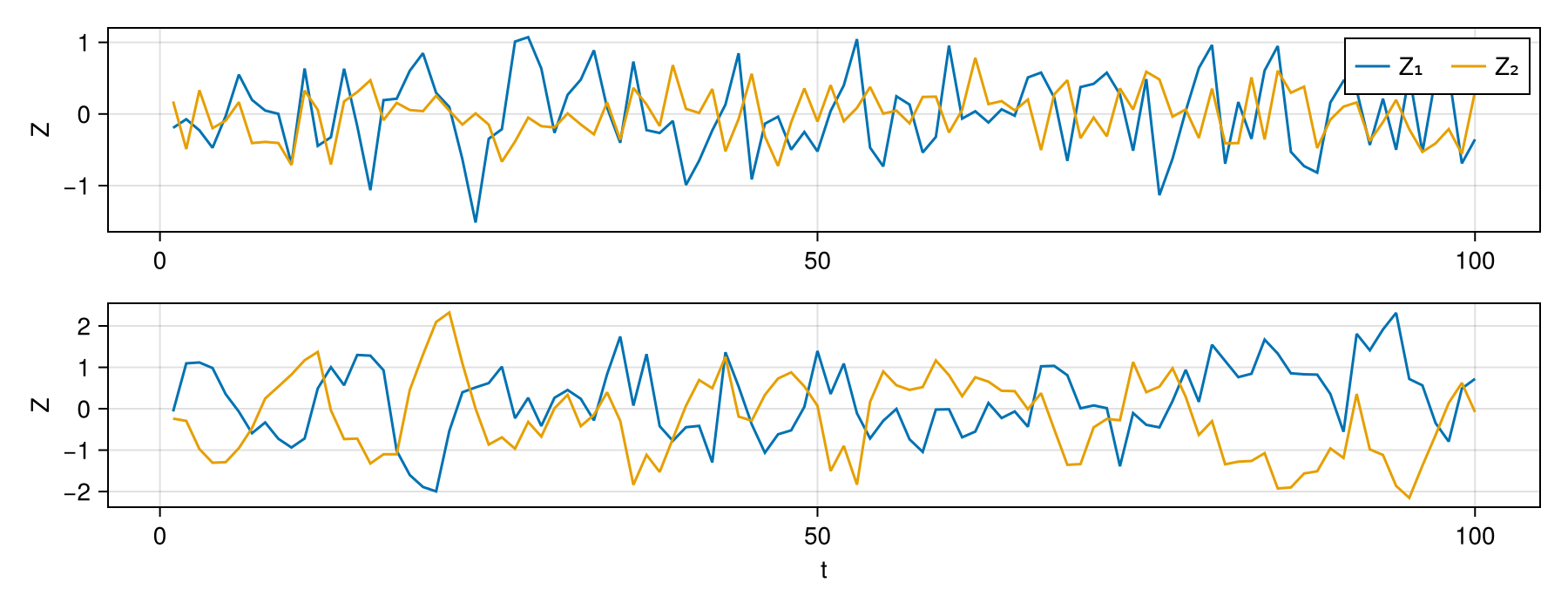
Constructing the neural network
Because the data are a time series, the neural network should capture temporal dependencies. Two natural choices are a 1D CNN (which extracts local patterns via convolution over time) and an LSTM (which maintains a hidden state across the full sequence).
A common heuristic is to set the number of summary statistics
p = 2    # dimension of each observation
d = 6    # number of parameters (entries of A and innovation standard deviations)
num_summaries = 3dnetwork = Chain(
# 1D CNN: convolve over the time dimension
x -> permutedims(x, (2, 1, 3)), # CNN expects time-step along first dimension
Conv((3,), p => 32, gelu; pad = 1),
Conv((3,), 32 => 64, gelu; pad = 1),
GlobalMeanPool(),
flatten,
Dense(64, 64, gelu),
Dense(64, num_summaries, gelu)
)network = Chain(
# LSTM: maps observation at each step to a hidden state
LSTM(p => 64),
x -> x[:, end, :], # take the final hidden state
Dense(64, 64, gelu),
Dense(64, num_summaries, gelu)
)Constructing the neural estimator
We now construct a neural estimator by wrapping the neural network in the subtype corresponding to the intended inferential method:
estimator = PointEstimator(network, d; num_summaries = num_summaries)estimator = PosteriorEstimator(network, d; num_summaries = num_summaries)estimator = RatioEstimator(network, d; num_summaries = num_summaries)Training the estimator
Next, we train the estimator using train:
K = 10000 # number of parameter vectors in the training/validation sets
T = 100 # number of time steps in each data setestimator = train(estimator, sampler, simulator; K = 10000, simulator_args = T)θ_train = sampler(K)
θ_val = sampler(K)
estimator = train(estimator, θ_train, θ_val, simulator; simulator_args = T)θ_train = sampler(K)
θ_val = sampler(K)
Z_train = simulator(θ_train, T)
Z_val = simulator(θ_val, T)
estimator = train(estimator, θ_train, θ_val, Z_train, Z_val)Training progress is reported in the terminal:

The empirical risk (average loss) over the training and validation sets can be plotted using plotrisk:
plotrisk()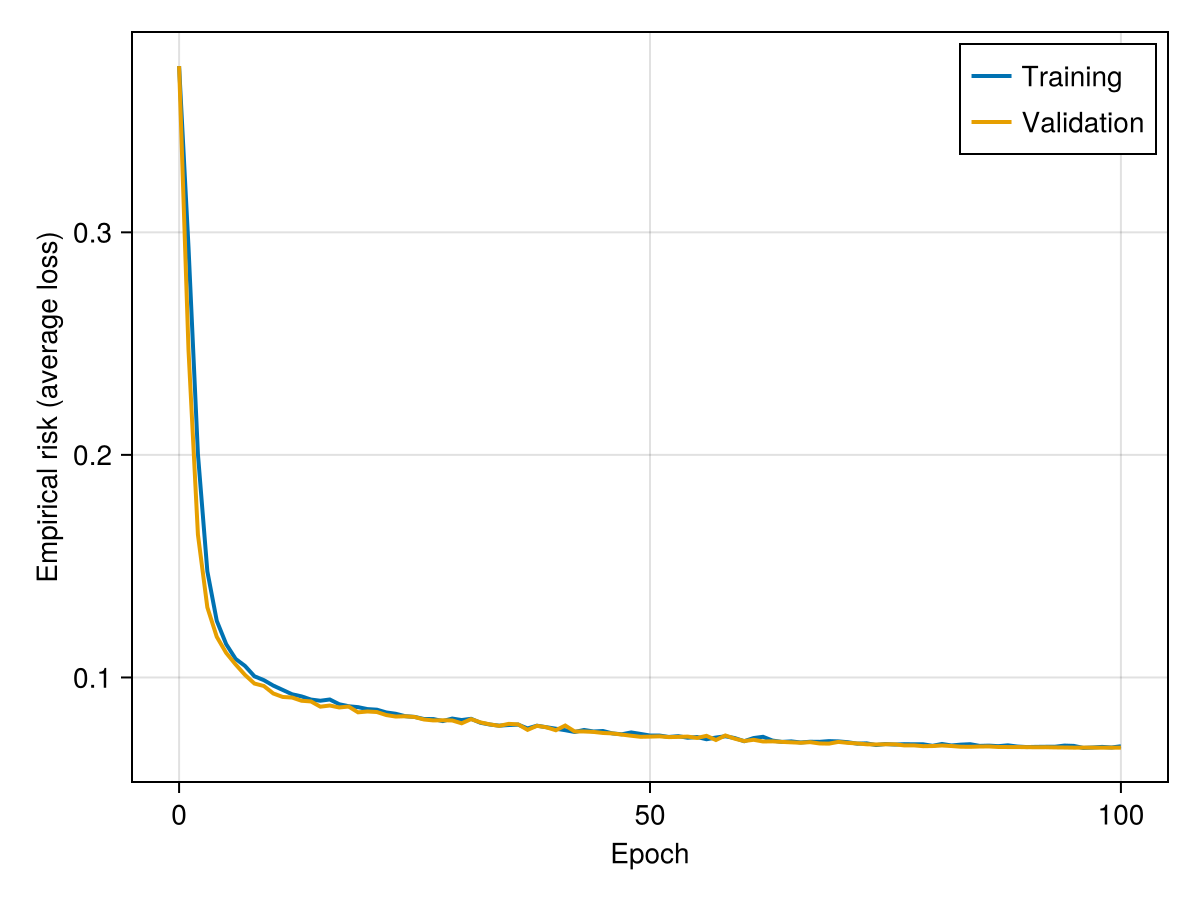
Assessing the estimator
The function assess can then be used to assess the trained estimator based on unseen test data simulated from the statistical model:
θ_test = sampler(1000)
Z_test = simulator(θ_test, T)
assessment = assess(estimator, θ_test, Z_test)
The resulting Assessment object contains ground-truth parameters, estimates, and other quantities that can be used to compute quantitative and qualitative diagnostics:
bias(assessment)
rmse(assessment)
plot(assessment)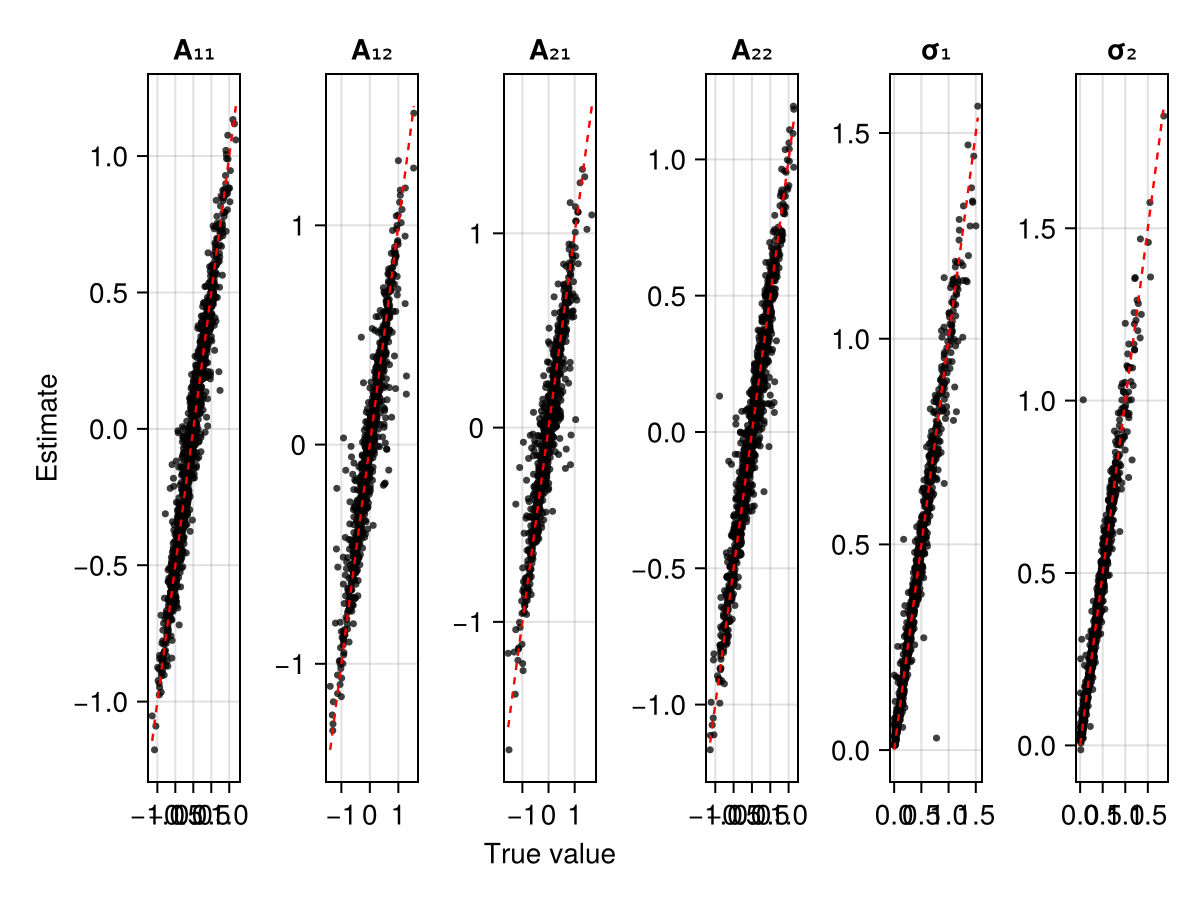
Applying the estimator to observed data
Once an estimator is deemed to be well calibrated, it may be applied to observed data (below, we use simulated data as a stand-in for observed data):
θ = sampler(1)                      # ground truth (not known in practice)
Z = simulator(θ, 100) # stand-in for a real VAR(1) time seriesestimate(estimator, Z) # point estimate of (A₁₁, A₁₂, A₂₁, A₂₂, σ₁, σ₂)sampleposterior(estimator, Z) # posterior samplesampleposterior(estimator, Z) # posterior sample